Tensegrity-Wheeled Jumping Robot
A lightweight robot that rolls on tensegrity wheels, squeezes them flat to change its shape, and jumps over obstacles with a snap-through spring.
Small robots for search and rescue or exploration need to cross rocks, steps, gaps, and soft ground, and survive falls. This robot rolls on two tensegrity wheels, open frames of carbon-fiber rods held together by elastic cables. The wheels are light, springy, and shock-absorbing, and they can be squeezed into flat disks to make the robot narrower and taller. A bistable spring under the body stores energy slowly and releases it in a snap, letting the robot jump onto obstacles up to 300 mm high.
At a glance
| Feature | Detail |
|---|---|
| Size | About 500 mm long, 400 mm wide, and 100 mm tall |
| Wheels | Two icosahedron tensegrity wheels: six 2 mm carbon-fiber rods and 3D-printed TPU elastic cables each |
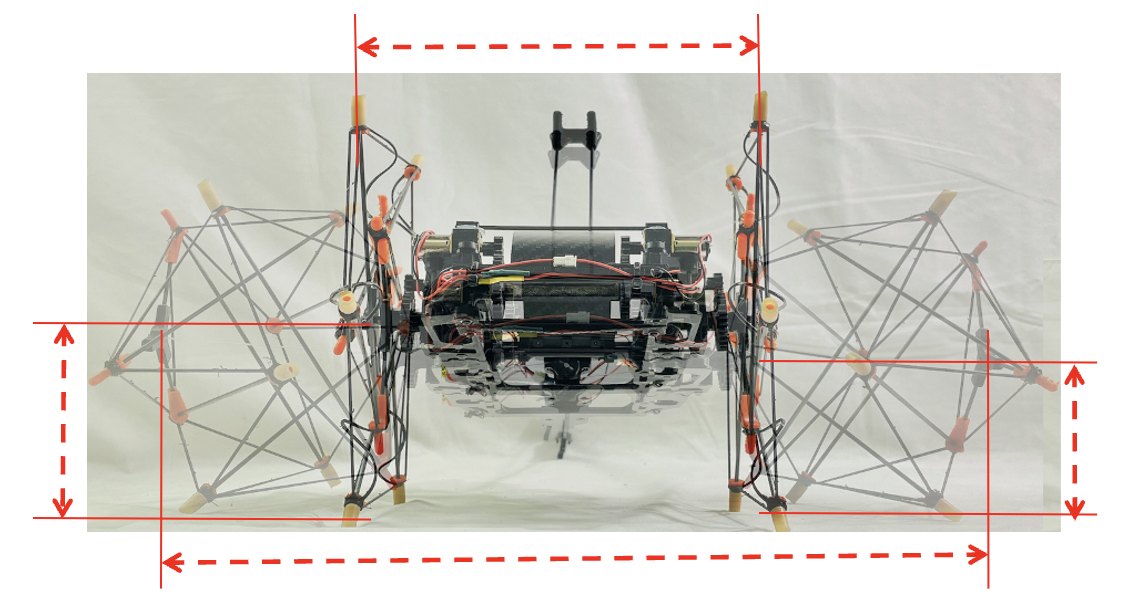
| Shape change | Collapsing the wheels shrinks the width from 400 to 180 mm and raises the body from 75 to 95 mm |
| Climbing | Steps up to 110 mm with expanded wheels and 150 mm with collapsed wheels; slopes up to 45° |
| Jumping | Bistable mechanism jumps onto obstacles up to 300 mm high |
| Speed and payload | Up to 0.36 m/s; carries about six times its own weight |
Tensegrity wheels that change shape
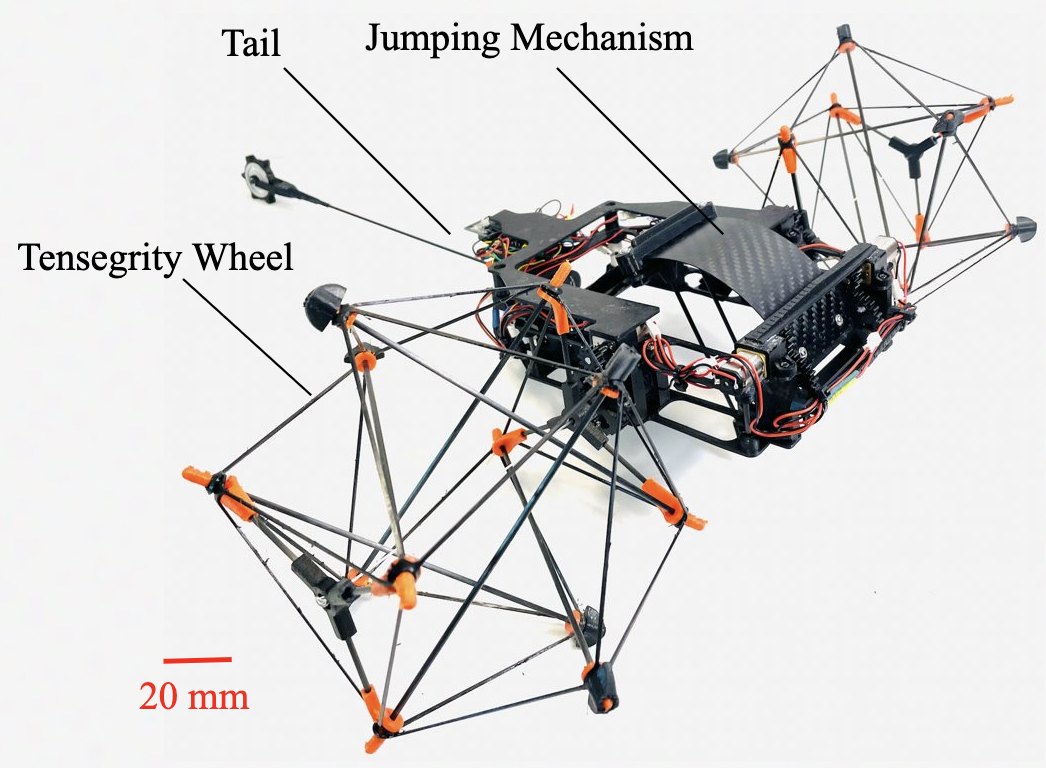
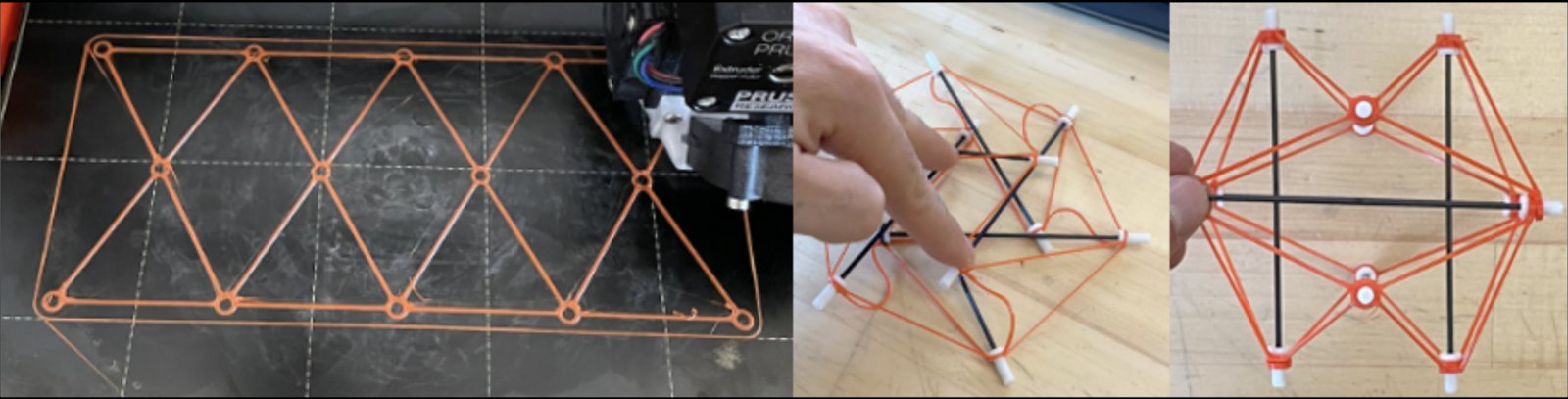
Each wheel is an icosahedron tensegrity: six stiff rods that never touch each other, held in shape by a network of stretchy cables. The cable network is 3D printed flat in soft TPU and then fitted onto the rods, so a wheel is cheap and quick to make. Because the whole wheel can flex, it absorbs impacts and conforms to rough ground without adding weight.
A small motor and pulley inside each hub pull the wheel’s two sides together, collapsing it into a disk. That makes the robot 55% narrower, so it can squeeze through tight gaps, and lifts its body higher off the ground.
The wheels’ rods also act like the spokes of a wheel-leg, catching the edge of a step. We built models that predict the tallest step a tensegrity wheel can climb, giving other designers a guide for sizing their own wheels. In tests the robot climbed steps up to 110 mm with expanded wheels and 150 mm with collapsed wheels.
Jumping with a bistable spring
A motor slowly loads a bistable mechanism until it snaps through to its other stable state, driving a foot hard against the ground. Storing energy slowly and releasing it all at once lets a small motor launch the whole robot onto a ledge, as high as 380 mm in this test.
Testing on slopes, obstacles, and natural terrain
In an obstacle course, the robot drove over a rock pile, jumped a 250 mm wall, crossed a rolling pipe and a 200 mm gap, climbed a 100 mm step, and went up a slope.
Outdoors, the robot rolled across snow, ice, grass, gravel, mulch, and sand, and changed its shape in tall grass.
Team
Sydney Spiegel, Jiefeng Sun, and Jianguo Zhao (Spiegel et al., 2023). Sydney led this work as an undergraduate researcher in the lab and won the top prize at CSU Demo Day with the robot.
References
2023
- T-Mech
 A Shape-Changing Wheeling and Jumping Robot Using Tensegrity Wheels and Bistable MechanismIEEE/ASME Transactions on Mechatronics, 2023