TeCoBot
Soft, snake-like robots built from tensegrity modules that link up into chains, loops, and branches to do what one robot can't.
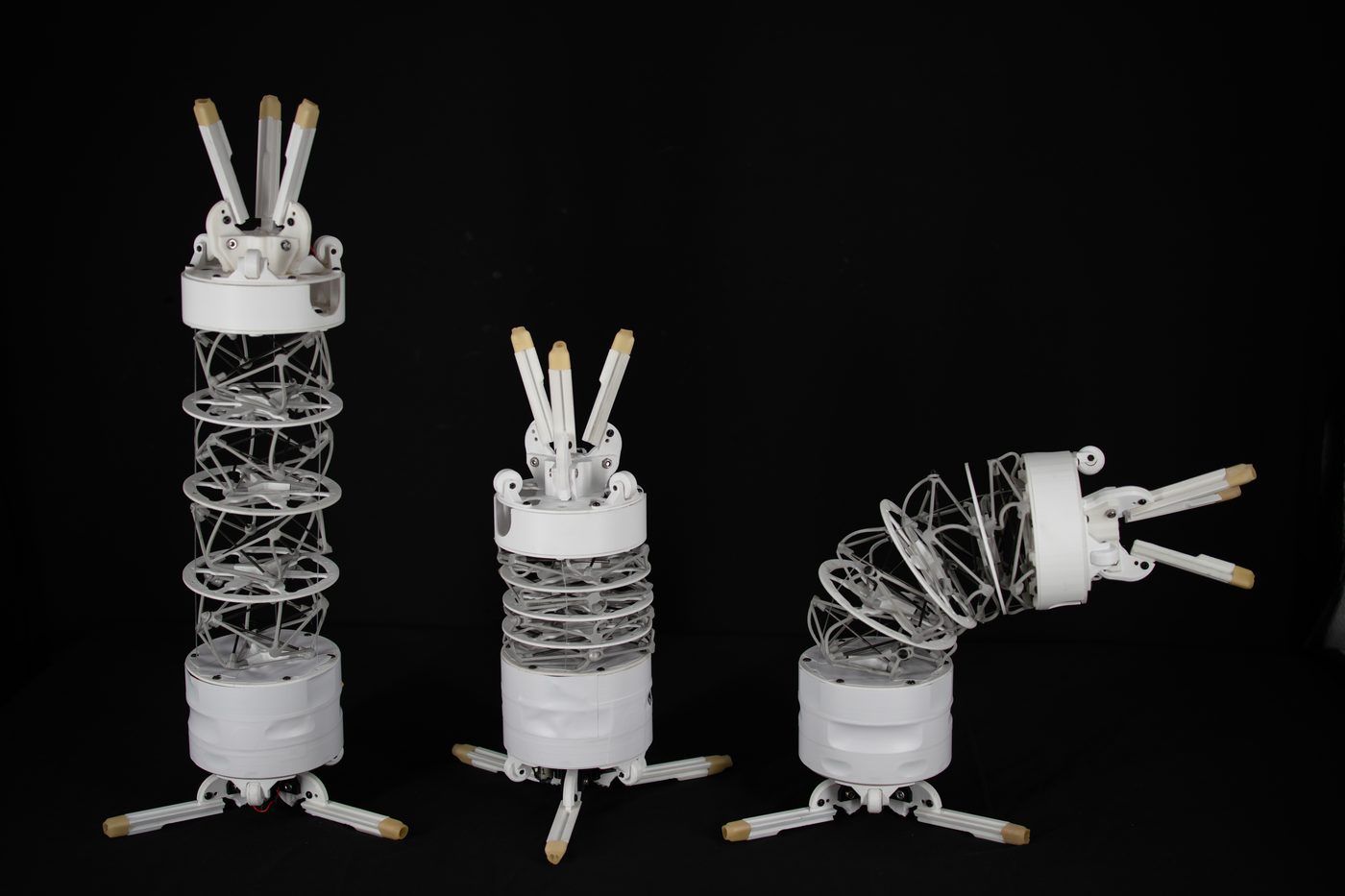
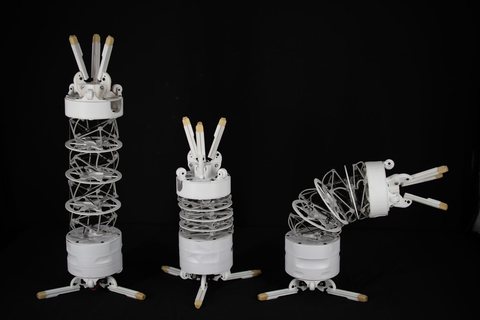
TeCoBot (Tensegrity-based Continuum roBot) is a soft, modular robot with a claw at each end. One TeCoBot can grab objects, inch like a worm, roll over rocks, and climb inside a pipe. The claw that grabs objects can also grab another TeCoBot, so a team of robots can link into chains, loops, an H shape, or a four-robot “lizard” and take on tasks that no single robot can do alone.
Paper arXiv Project site Code Video
At a glance
| Feature | Detail |
|---|---|
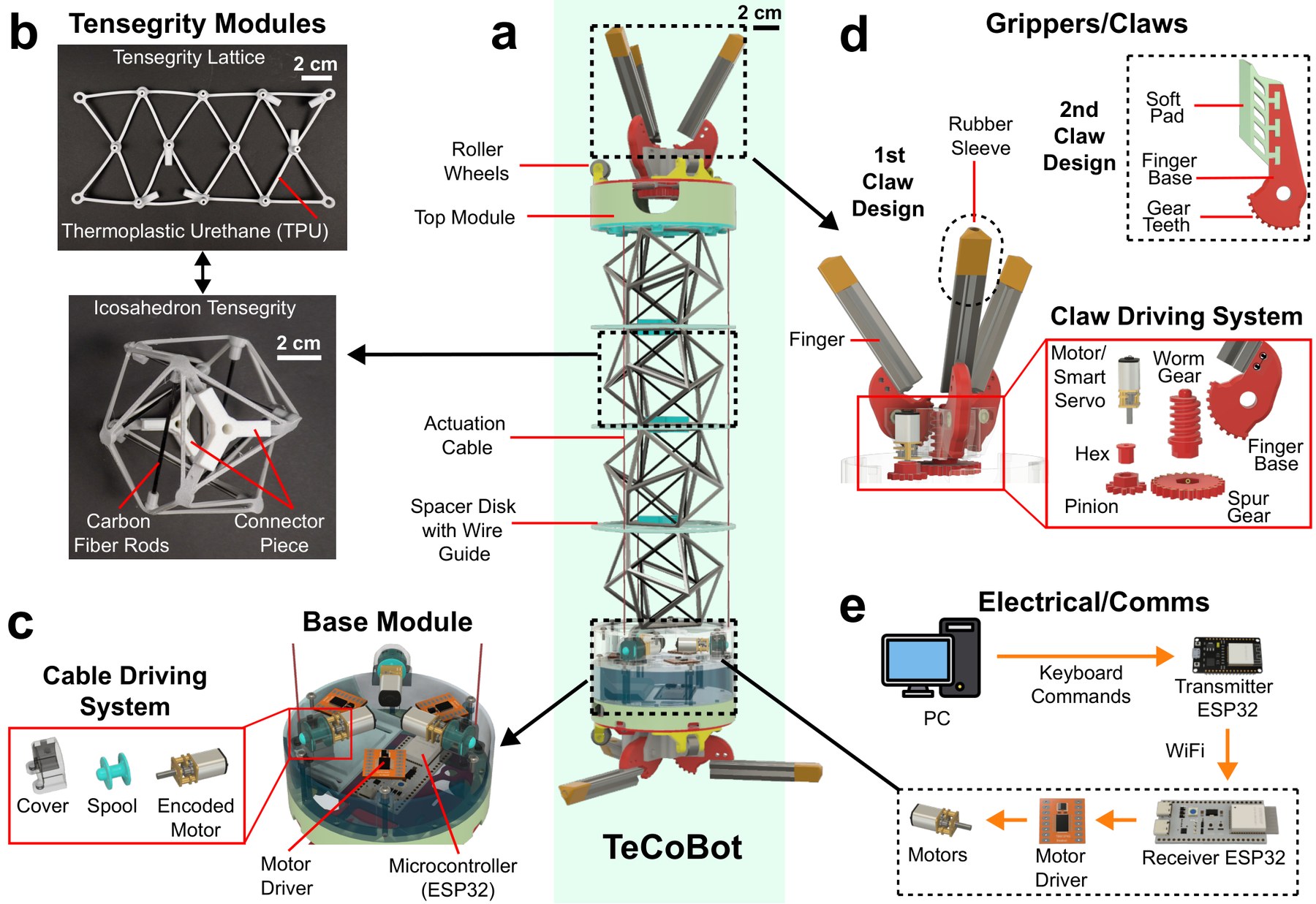
| Body | 4 stacked icosahedral tensegrity modules (carbon-fiber rods + 3D-printed TPU tendons) |
| Size and weight | 587 mm long, 110 mm diameter, about 600 g without batteries |
| Actuation | 3 cables, 120° apart, driven by encoded DC motors in the base |
| Motions | Axial collapse/extension and bending in any direction |
| End effectors | Swappable claws at both ends, driven through a self-locking worm gear |
| Control | Wireless (Wi-Fi) through ESP32-S3 boards; robots can be driven alone or in sync |
| Top speed | 30 mm/s rolling on smooth wood |
How it is built
Each module is an icosahedral tensegrity: six rigid carbon-fiber rods held together by one stretchable tendon network, which is 3D printed flat in TPU and then assembled into 3D. The rods carry compression and the elastic tendon carries tension, so the module is stiff enough to bear loads yet can collapse and bend and then spring back.
Four modules are stacked into a continuum body. Three cables run along the body; pulling them together collapses the robot, and pulling them unequally bends it in any direction. A useful property of stacking is that adding modules increases how far the robot can collapse and bend without increasing the force the motors must supply.
A base module holds the motors, encoders, and electronics, and a top module carries the main battery. Each end has a claw. The claws are used both to grasp objects and to dock with other TeCoBots.
One robot on its own
A single TeCoBot works as a small manipulator: it can pick a grape and drop it into a jar. It can also move in six ways: extending and compressing, inching like a worm, crawling, rolling, turning, and climbing inside a pipe. We tested it on eight outdoor terrains, from grass and gravel to rocks and hay. Rolling worked on almost all of them.
Linking up and moving together
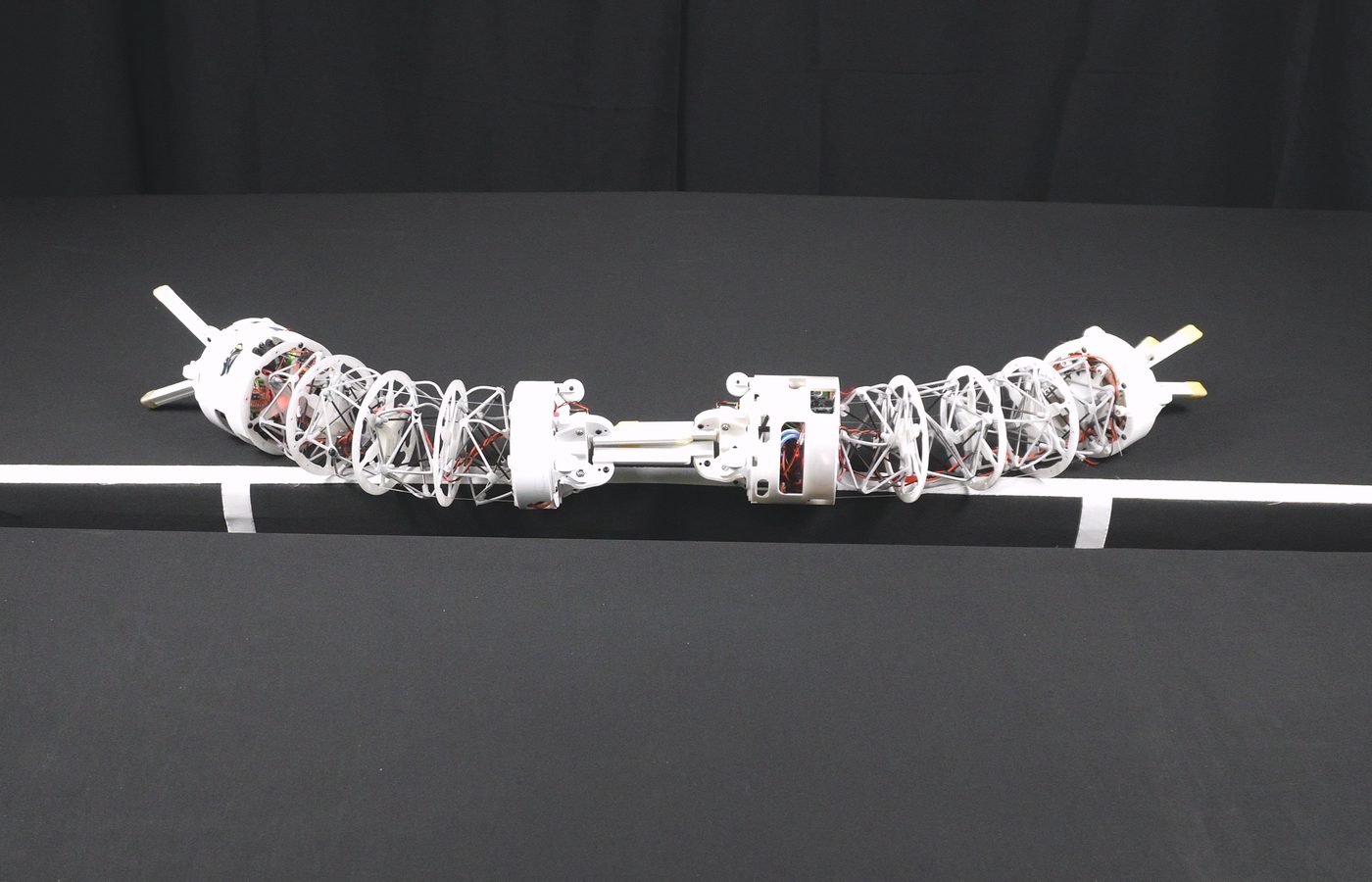
TeCoBots dock claw-to-claw or claw-to-body, and they can undock and reconnect in a different shape. Because each robot stays soft after docking, the combined body can still bend and collapse. Different shapes suit different places:
- Chain: the middle robot pushes and pulls while the end claws take turns anchoring.
- Loop: the robots wrap around a large object, or roll together along a pipe.
- H shape: the robots climb through a rectangular duct.
- Two robots linked end to end can roll across a gap that one robot cannot cross, and four robots can move like a lizard.
Working together
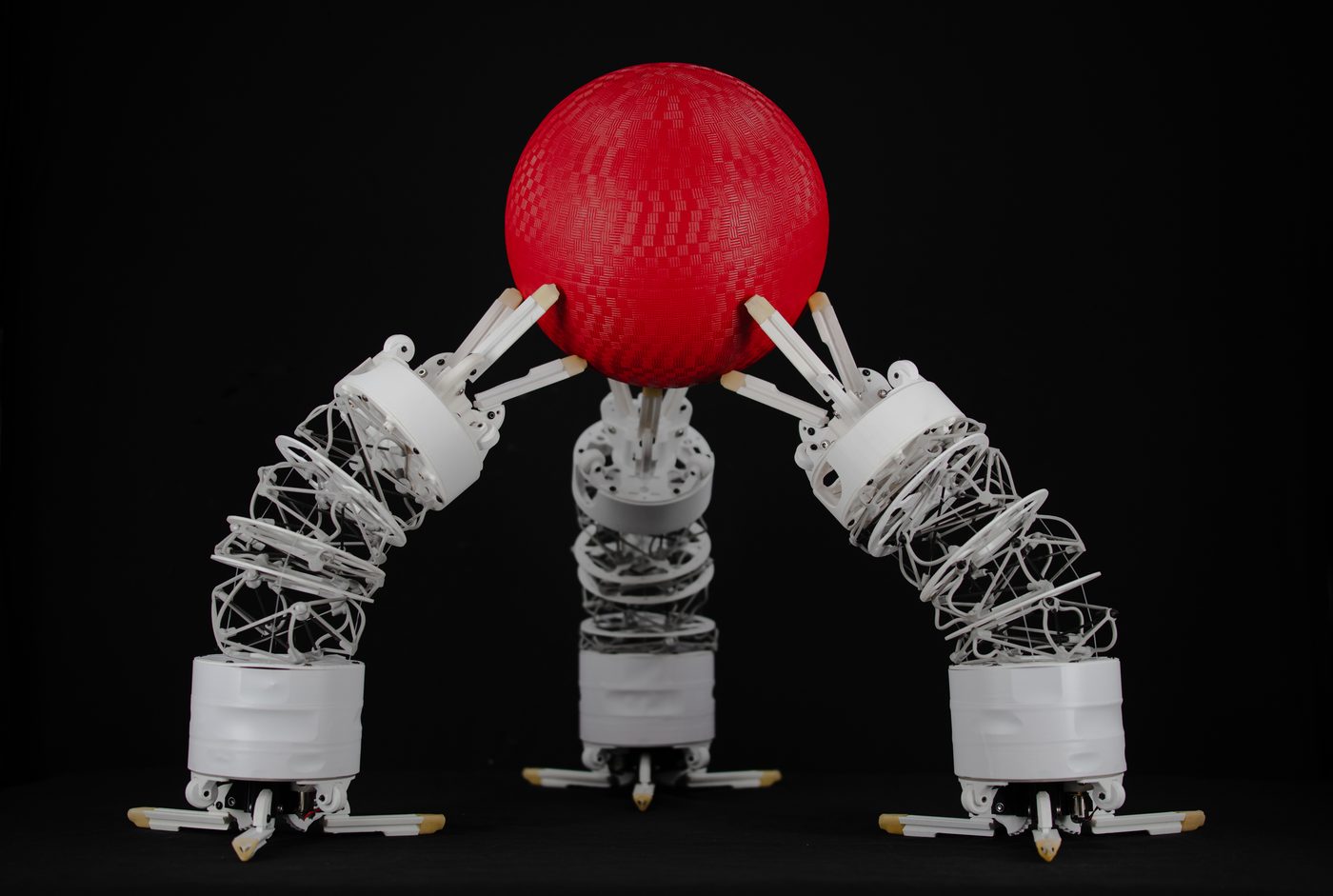
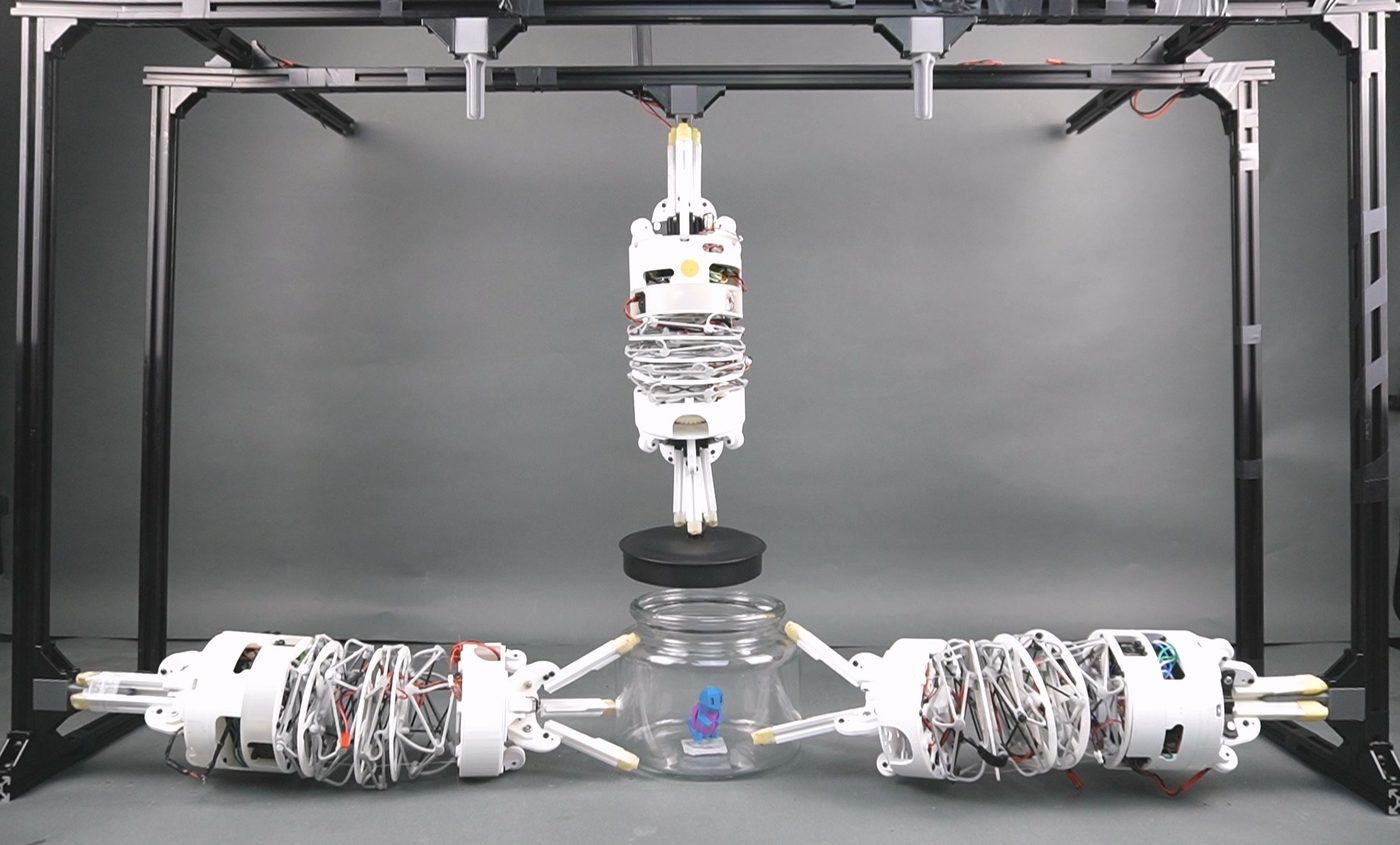
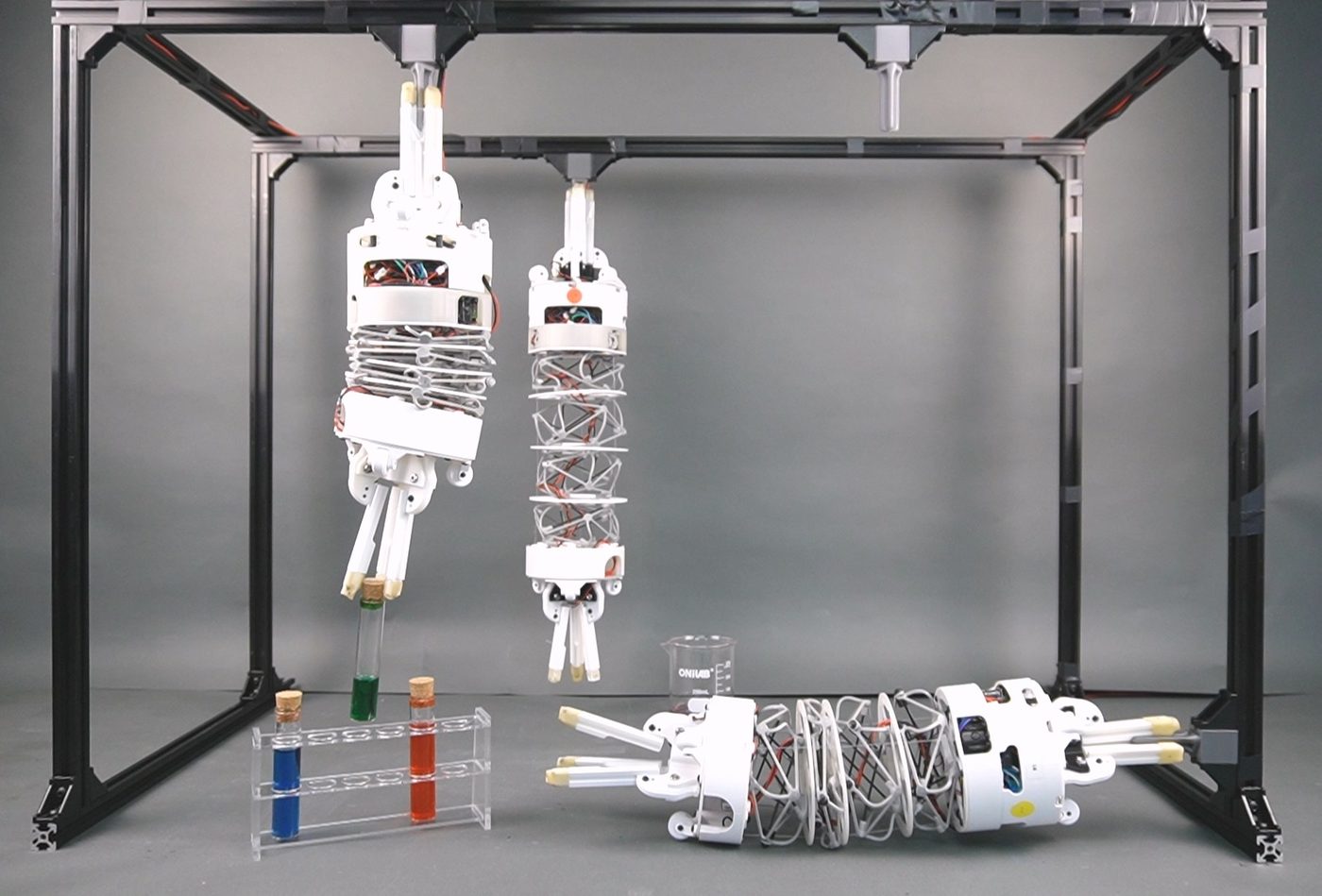
When docked to a frame, three TeCoBots can rearrange themselves for different jobs: three hanging robots lift a large ball, two robots pick up a test tube and pour from it, the robots hold a jar while another opens it, and a chain of robots reaches objects too far away for one.
Real-world tasks
Combining these skills, three TeCoBots cleaned up a desk: they lifted one robot onto the table, put a pen back in its holder, handed a piece of scrap paper down the chain, and carried it to the trash bin. In a second task they organized a cabinet, opening a drawer and handing a motor from a supply bin into it.
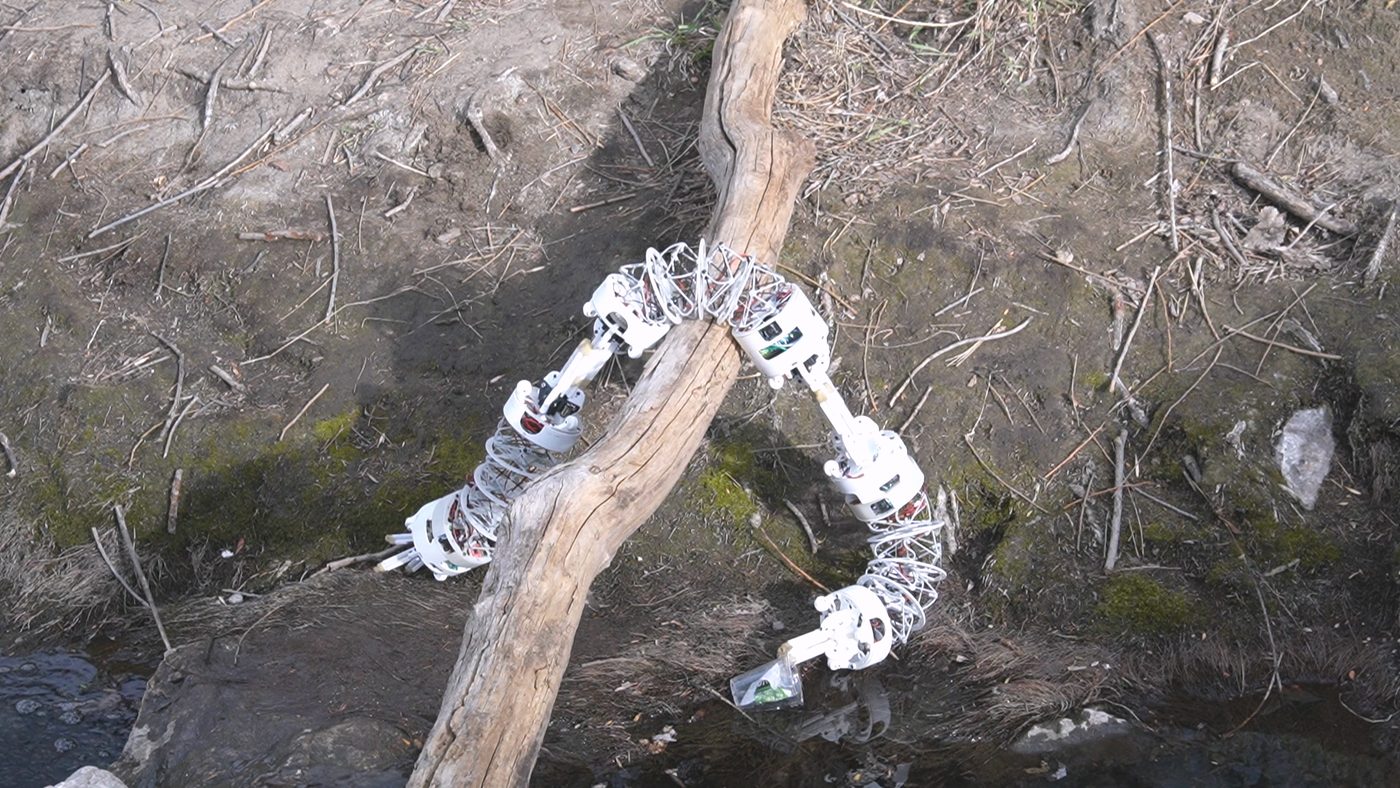
Outdoors, linked TeCoBots climbed down to a stream to pick trash out of the water, and rolled a beaker to a bush to collect a plant sample.
Autonomous docking
In the demonstrations above, a person drives the robots and decides how they reconfigure. As a proof of concept, we also showed that a TeCoBot can dock by itself: a small onboard camera tracks markers on the partner robot, corrects its alignment, and locks on.
All footage is sped up.
Team
Mahmud Hasan Saikot, Sydney Spiegel, Sudheera Akalanka Kariyawasam, Andrew Stefka, Josh Chrisler, and Jianguo Zhao. The work is published in Nature Machine Intelligence (Saikot et al., 2026).