Stiffness-Programmable Origami Robot
A 3D-printed, three-fingered origami robot that grasps and walks in different ways under the same motor commands, just by changing how stiff its creases are.
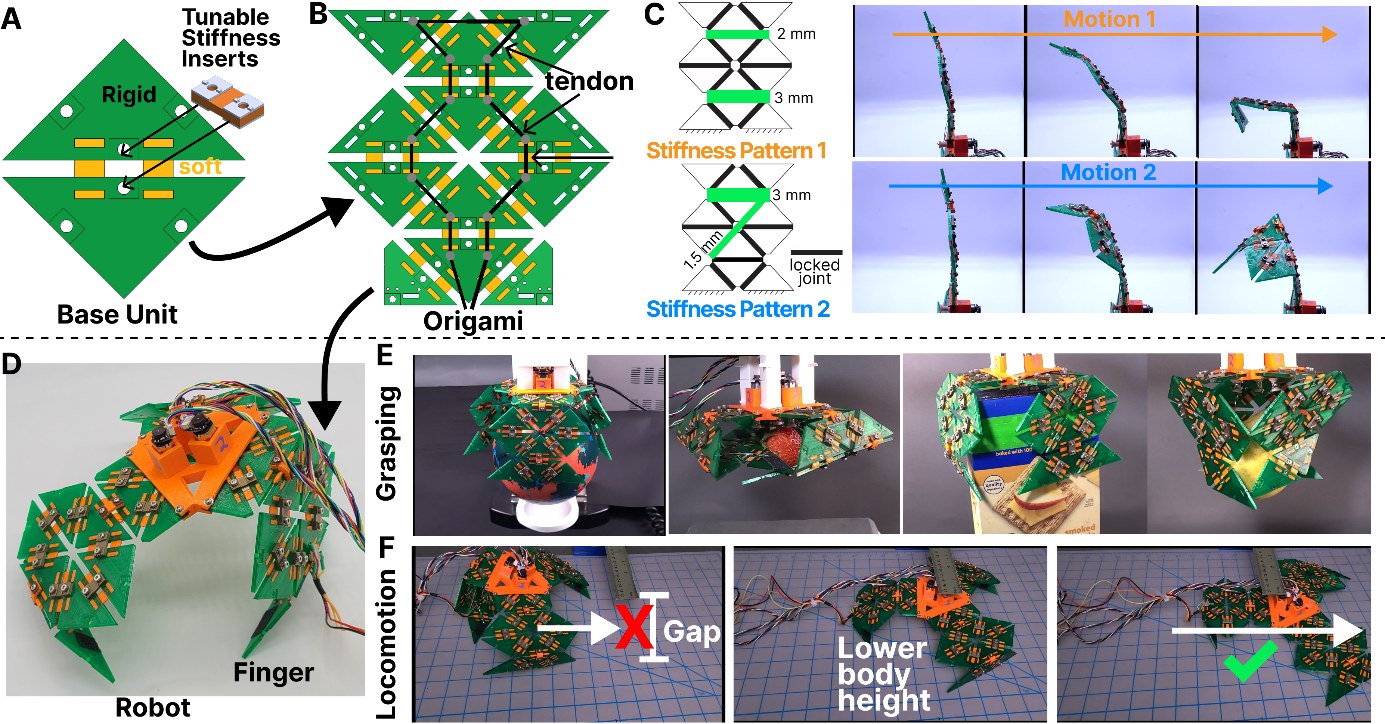
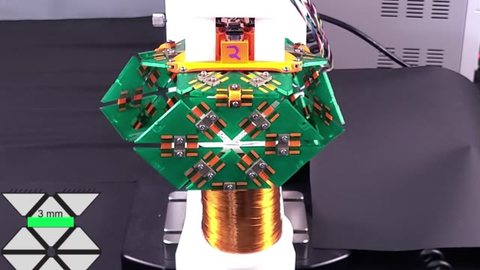
Origami robots fold flat sheets into moving structures, but making one structure do many different things usually means adding more motors. This robot takes a different route: every finger is pulled by a single tendon, and what the finger does depends on how stiff each crease is. Swap a few small inserts, or heat one of them, and the same motor command makes the finger curl, hook, twist, or stay flat. With three such fingers, the robot can grasp objects from strawberries to a 480-gram cucumber, and it can walk with two different gaits.
Paper (open access) Earlier paper (2024)
At a glance
| Feature | Detail |
|---|---|
| Structure | Modified Yoshimura origami, printed in one piece: rigid PETG panels joined by soft TPU creases |
| Stiffness control | Swappable inserts on each crease: locking, fixed-stiffness, or heated variable-stiffness |
| Actuation | One tendon per finger, driven by a geared DC motor with an encoder |
| Robot size | 330 mm across and 50 mm tall when relaxed; three fingers on a soft TPU palm |
| Grasping | Paper roll, 454 g wire spool, foam globe, strawberry, spray bottle, cucumber, box, pear |
| Locomotion | Crawling (24 mm per cycle, 80 mm tall) and crutching (69 mm per cycle, 120 mm tall) |
How it is built
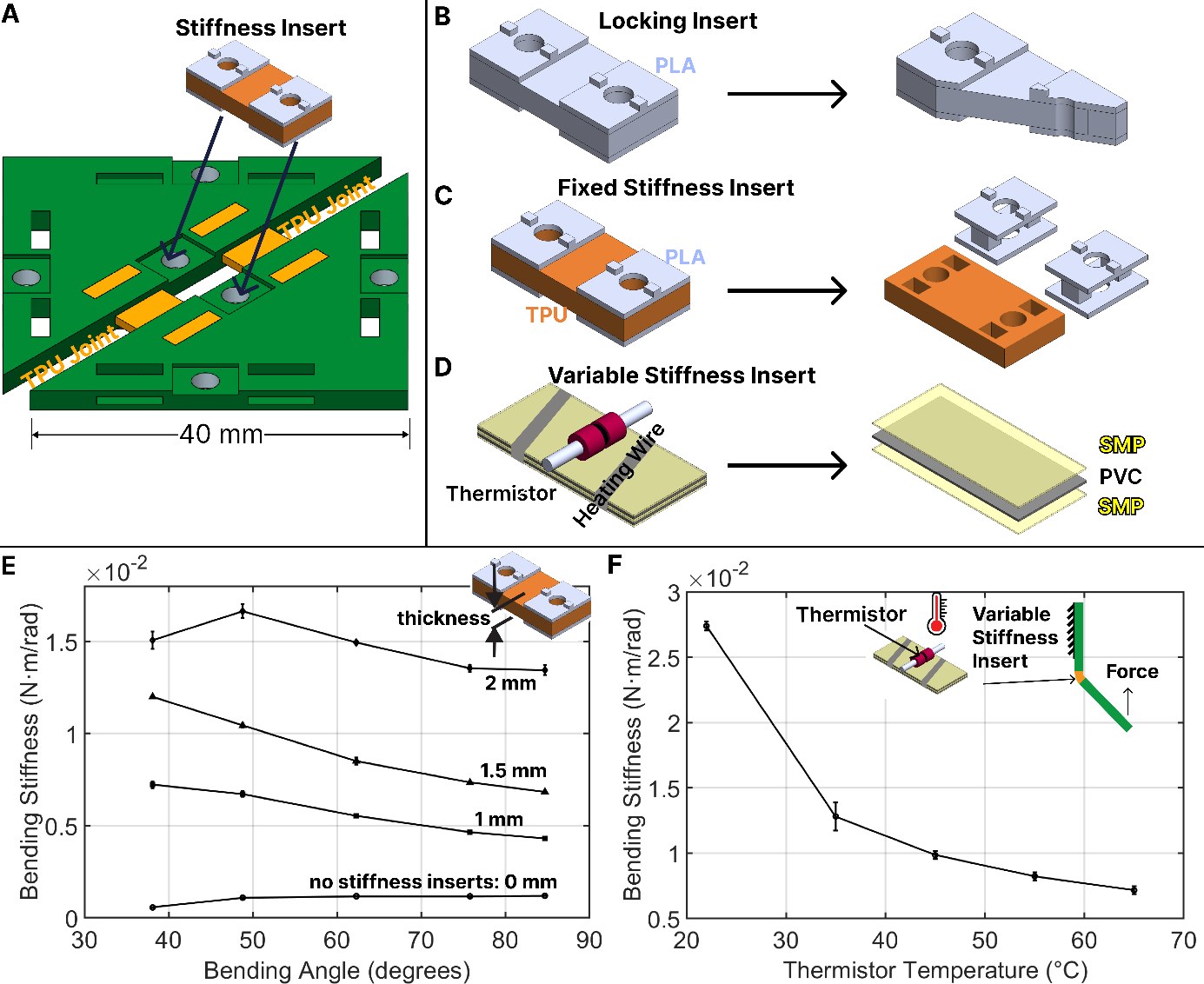
Each building block is a pair of rigid triangular panels joined by a soft crease, made in a single print on a regular multimaterial FDM 3D printer, with no assembly of the hinge. Each crease has a slot for a small stiffness insert:
- a locking insert (PLA) that stops the crease from bending;
- a fixed-stiffness insert, a TPU strip between two PLA plates, whose thickness sets how stiff the crease is;
- a variable-stiffness insert, a layered shape-memory-polymer and PVC strip with a heating wire and temperature sensor. Heating it softens it to roughly a quarter of its room-temperature stiffness, so a crease can switch between stiff and soft while the robot runs.
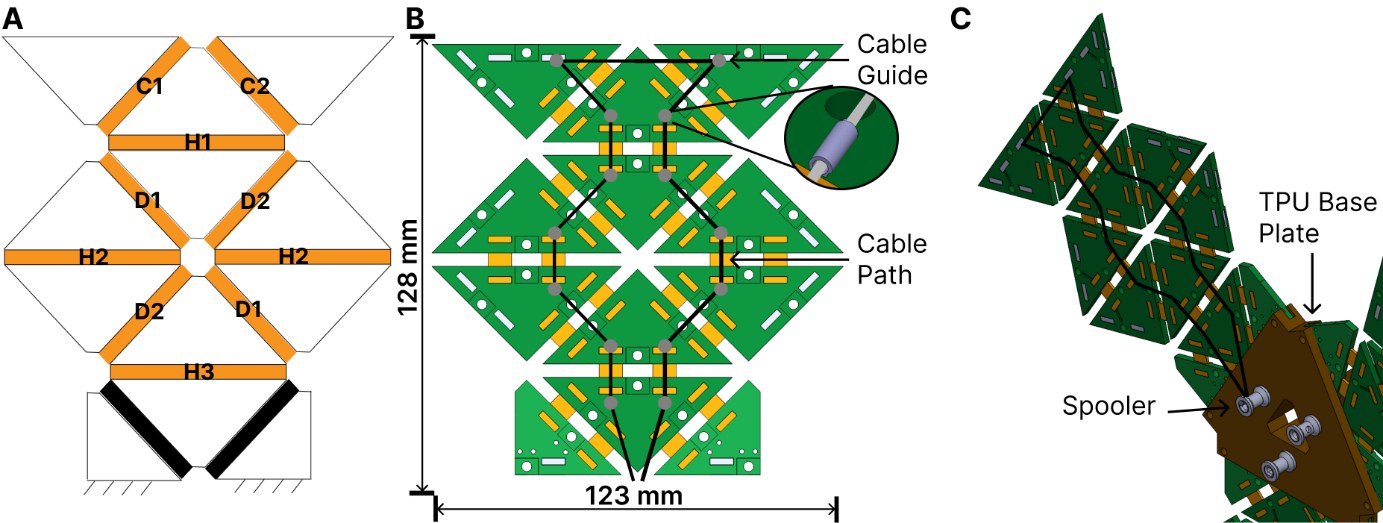
The finger is a flattened section of a Yoshimura origami pattern with three bending creases, two diagonal creases for twisting, and two clamping creases at the tip. A thin metal tendon runs through small guides on the panels, so one motor pulls on all the creases at once. The stiffness pattern decides which creases give way first.
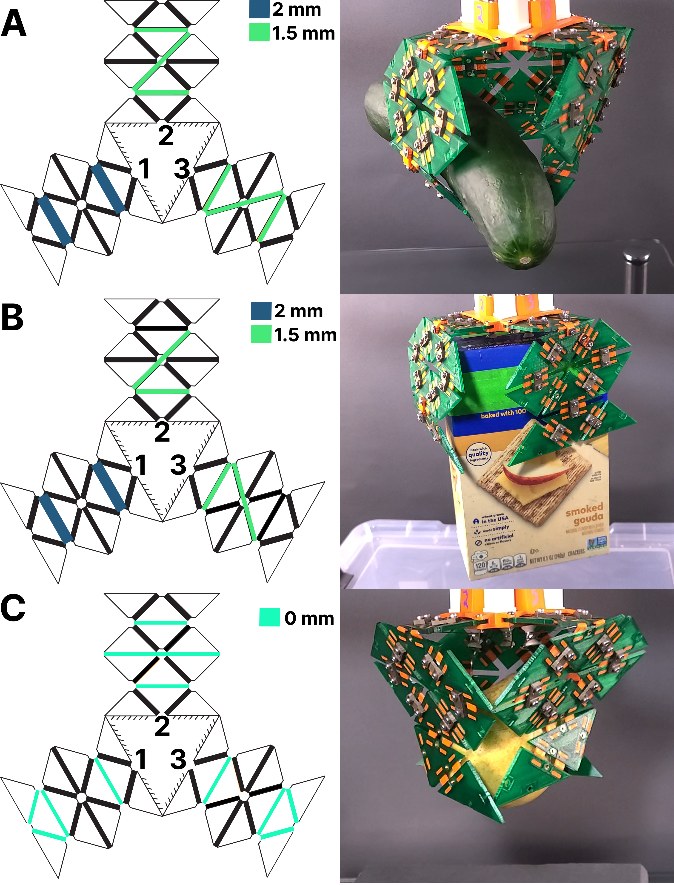
Same finger, same tendon pull, different inserts: as the inserts on the bending creases change (labels at top, insert thickness in mm), the finger bends at a different crease and ends in a different shape.
A simple model, based on the finger’s geometry and the tendon tension, predicts how much each crease bends for a given tendon pull, and experiments match it across the stiffness patterns we tested.
Grasping
With the same stiffness pattern on all three fingers, the robot can be set up for a specific object: a short pattern for a paper roll, a hooked pattern to lift a 454 g wire spool by its rim, and a curved pattern to wrap around a foam globe. Softer patterns let the fingers simply conform, which is enough to cradle a strawberry or hold a spray bottle.
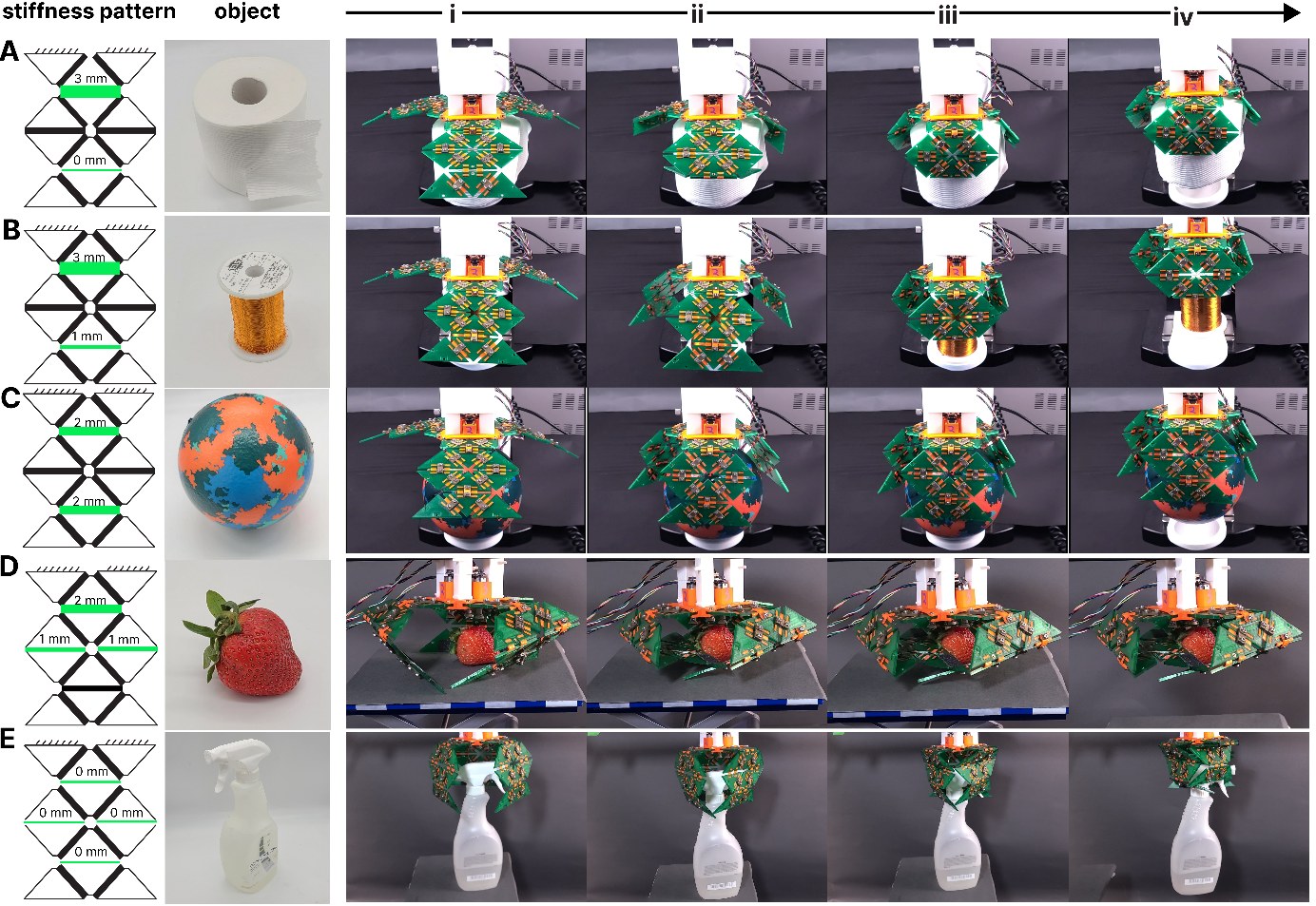
Giving each finger a different pattern unlocks more specialized grips: a pincer grip on a heavy cucumber, a parallel grip on a cracker box with two twisting fingers, and a gentle cradle for a pear.
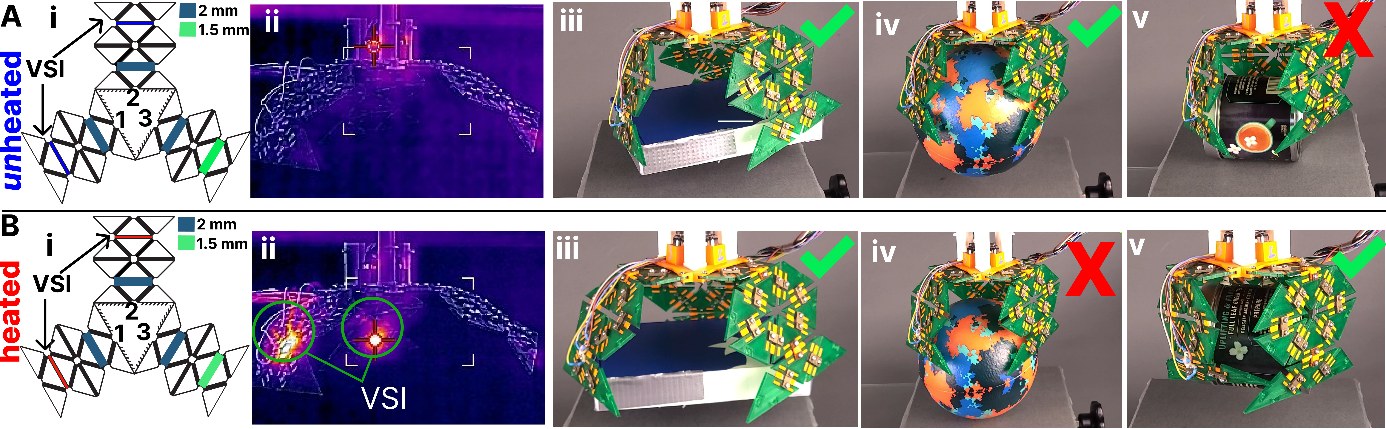
With variable-stiffness inserts, the robot changes its grip without anyone touching it. Cold, the inserts keep the fingers flat for clamping a box or a ball; heated, the fingers curl around a cylindrical tea canister that the flat grip cannot hold.
Walking
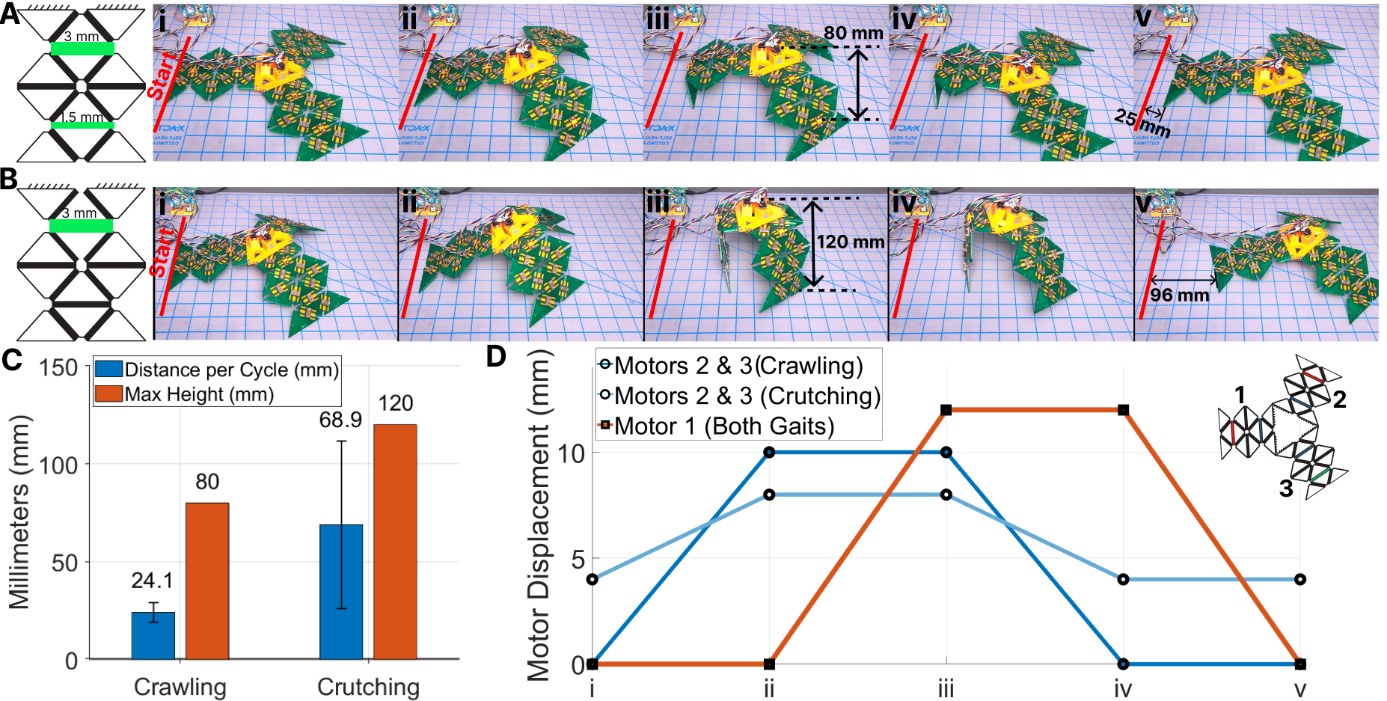
The same three fingers can also walk. One finger pushes while the other two support the body. Where the stiffness pattern stores elastic energy decides the gait: bending the tip creases gives a low, steady crawl (about 24 mm per cycle, 80 mm tall), while bending the base creases gives a taller, longer-striding crutching gait (about 69 mm per cycle, 120 mm tall).
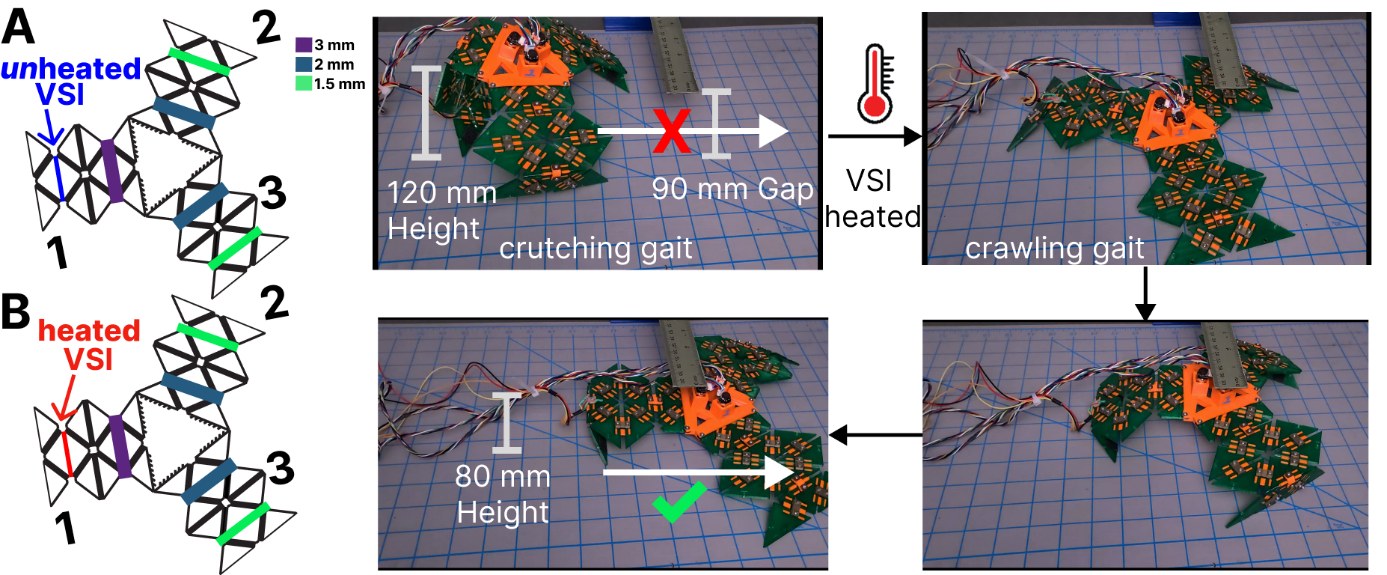
Heating a single variable-stiffness insert switches the gait on the spot. Crutching is too tall to fit under a 90 mm gap; after the insert is heated, the robot drops to a crawl and passes underneath, with the same motor commands throughout.
Earlier version: variable-stiffness joints (2024)
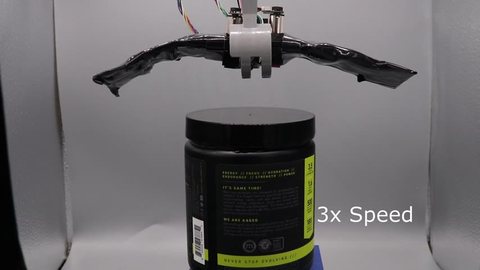
This robot builds on our earlier origami module with four variable-stiffness joints, each a thermoplastic layer sandwiched between shape-memory-polymer layers and softened by Joule heating. Two of those modules formed a small robot that could inch, undulate, and crawl like a turtle, and the same pair worked as an adaptive gripper.
Team
Elisha Lerner and Jianguo Zhao (Lerner & Zhao, 2026). The earlier version was developed with Zhe Chen (Lerner et al., 2024).
References
2026
- Adv. Robot. Res.
 Stiffness-Programmable Origami Robots With Tendon-Driven Actuation via Multimaterial 3D PrintingAdvanced Robotics Research, 2026
2024
- Phil. Trans. A
 Reconfigurable Origami with Variable Stiffness Joints for Adaptive Robotic Locomotion and GraspingPhilosophical Transactions of the Royal Society A, 2024