Origami-Inspired Reconfigurable Robot
A four-legged robot built from origami-inspired modules whose joints switch between soft and rigid, so the same legs can walk, crawl, inch, or grasp.
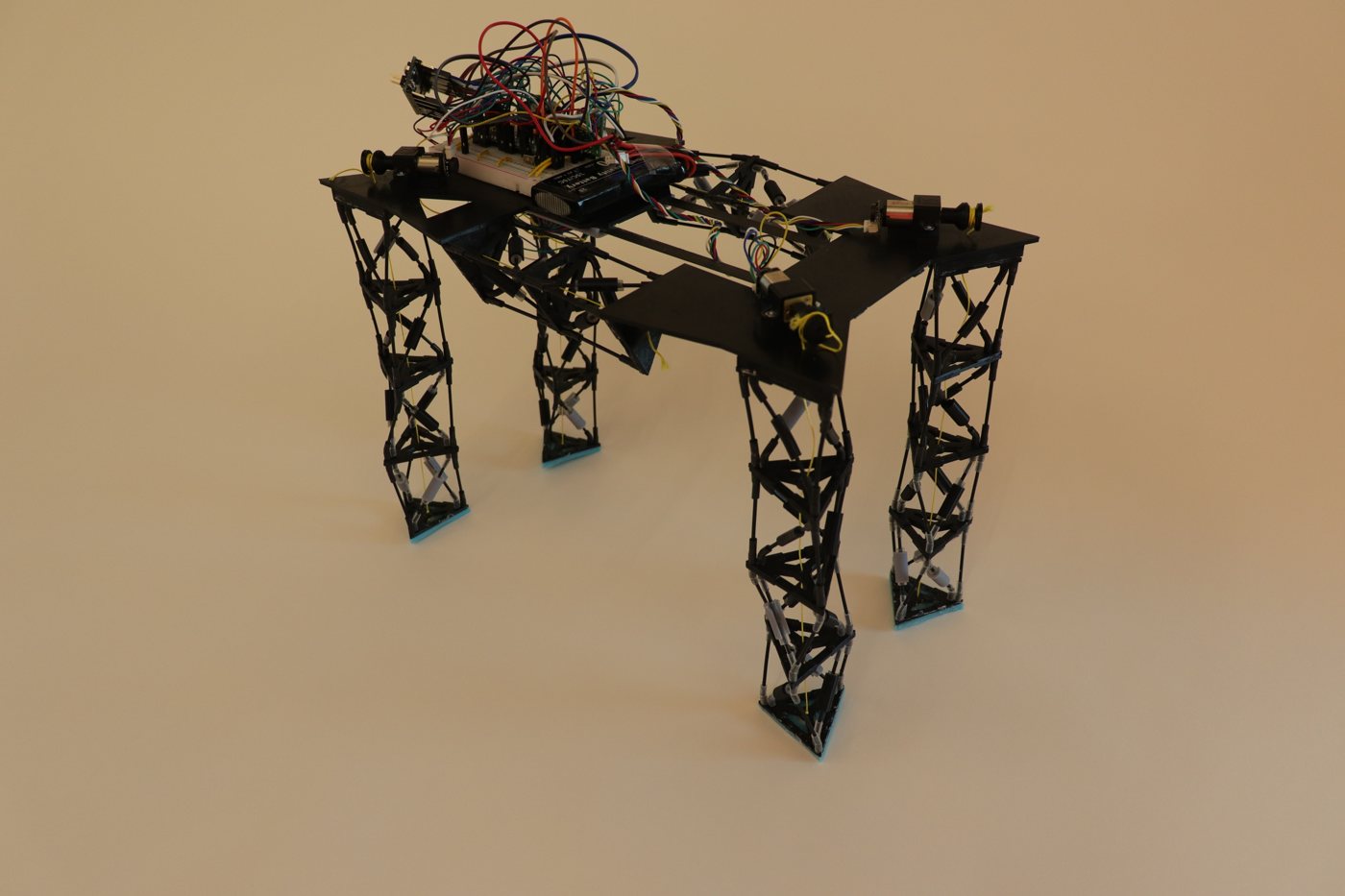
A frog walks, jumps, swims, and climbs with the same body and legs, just held in different configurations. Most robots, in contrast, need a separate mechanism for each way of moving. This robot takes the frog’s approach: its legs are stacks of small origami-inspired modules whose joints can each be made soft or rigid. Pulling the same tendon then produces a different motion depending on which joints are soft, so the same four legs can walk, crawl, inch, or act as arms to grasp.
At a glance
| Feature | Detail |
|---|---|
| Module | Two triangular plates (45 mm sides) joined by three vertical links and three diagonal links, driven by a tendon |
| Joint | Shape-morphing variable-stiffness joint: a PLA rod in an elastic tube, softened by a heating wire |
| Module motions | Collapse, bend, or slant under the same tendon pull, depending on which joints are soft |
| Model | Kinematic model predicts the module’s motion with a mean error of 2.4 mm |
| Robot | Four legs, each made of four modules in series |
| Locomotion | Walking (28 mm/s), crawling (21 mm/s), crawling while grasping with two legs (21 mm/s), and inching |
The module and its joints
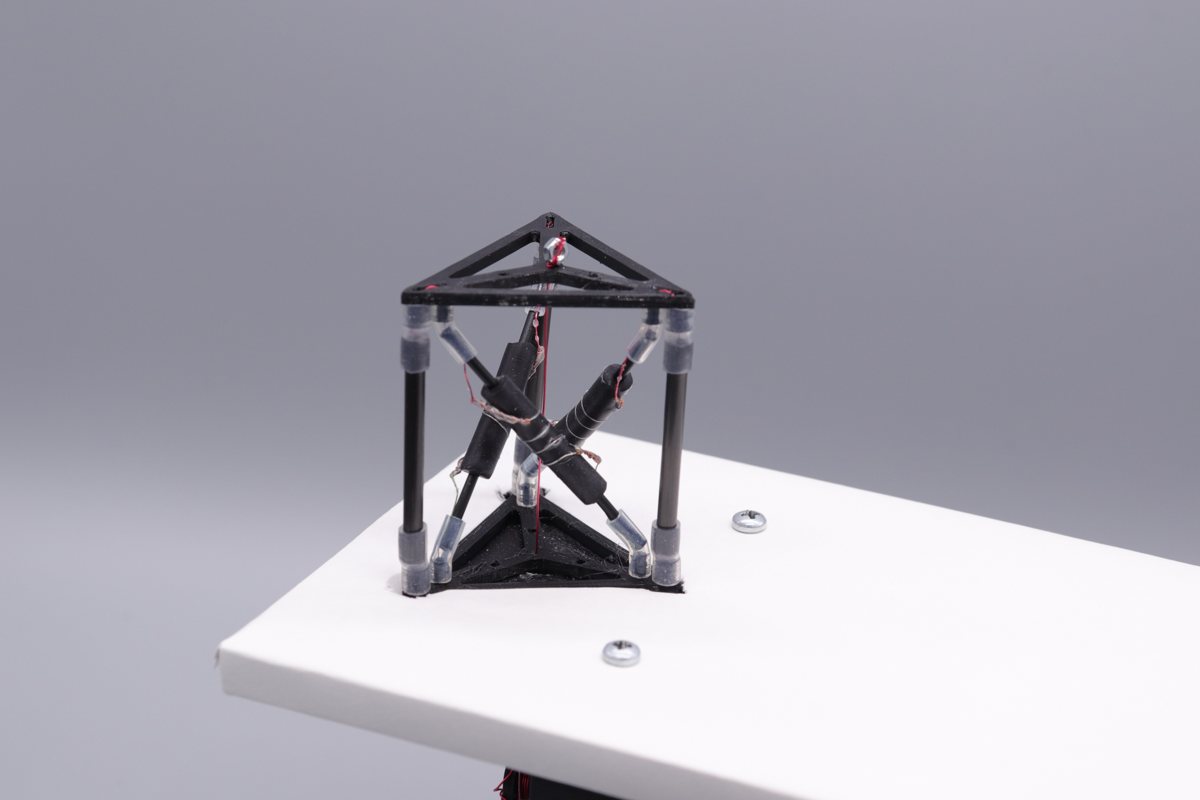
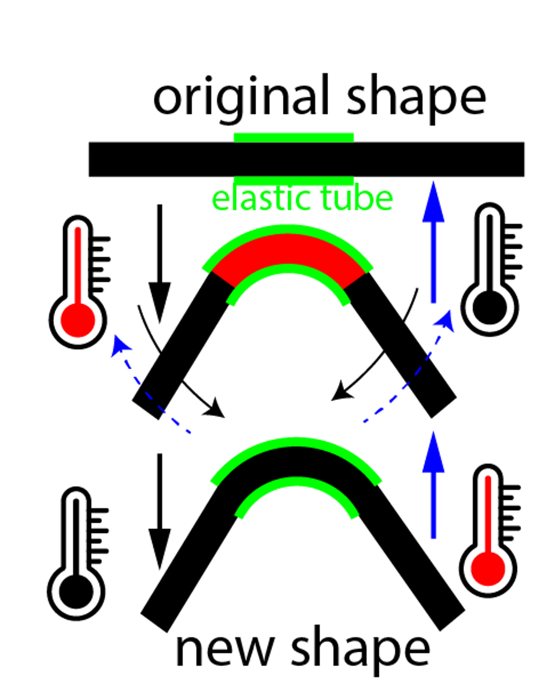
Each module is a pair of triangular plates connected by three vertical links and three diagonal links. Each diagonal link has a shape-morphing variable-stiffness joint: a thermoplastic (PLA) rod inside an elastic tube, wrapped with a heating wire. Three volts heat the rod soft in about 20 seconds so the joint can bend; when it cools, the joint becomes rigid again, either straight or frozen in its new bent shape (right).
A single tendon pulls the top plate down. Which joints are soft decides what happens:
Stacking modules multiplies the options. Two modules in series can collapse or bend either module, or both, giving a much larger set of shapes and motions from one tendon.
A robot that walks, crawls, inches, and grasps
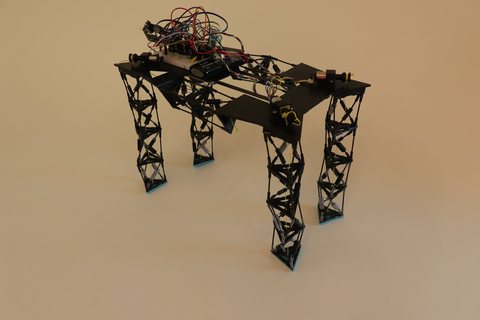
The robot has a three-part body and four legs, each made of four modules in series and driven by a tendon. By choosing which joints are rigid in each leg, the same robot moves in different ways:
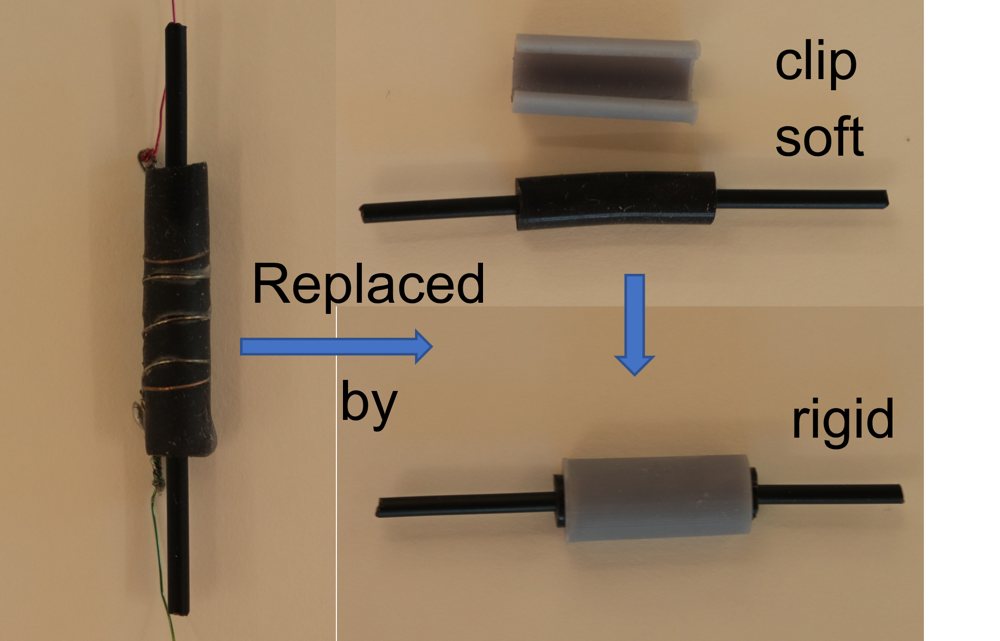
For these robot demonstrations, the heated joints were replaced by small clips that make a joint soft or hold it rigid, straight or bent, and the legs were reconfigured by hand between modes. Using the heated joints throughout would let the robot reconfigure itself without manual help.
Follow-up: learning the best stiffness for a task (2026)
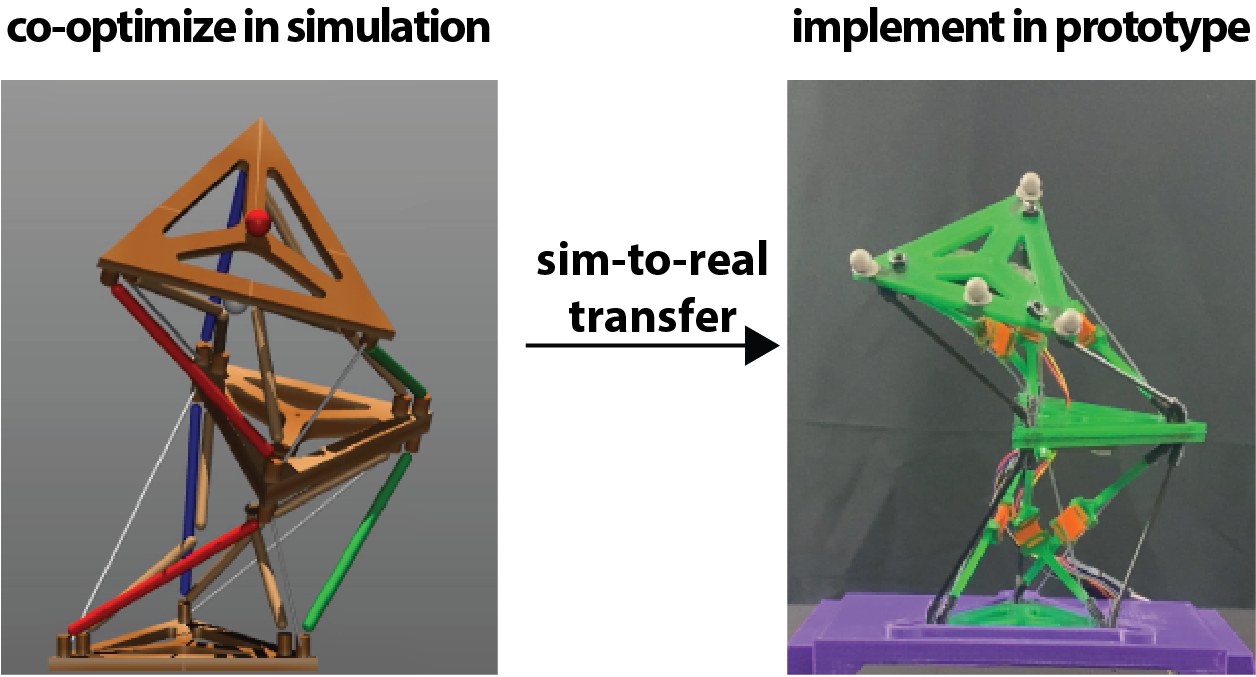
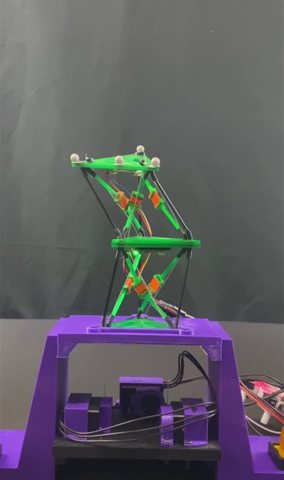
In the original robot, we picked which joints to make soft by trial and error. In a follow-up study with collaborators at UMass Amherst, we let a computer decide. Using a two-module, tendon-driven manipulator, a reinforcement learning framework in the MuJoCo physics simulator learns the joint stiffnesses and the tendon control policy together for a reaching task. The learned stiffnesses are built into a physical prototype with fixed-stiffness joints, and the learned controller transfers directly: the real manipulator reaches its targets repeatably, with a final position error below 2 mm.
Team
Zhe Chen, Brandon Tighe, and Jianguo Zhao (Chen et al., 2022). The follow-up was done with Li Chen and Hao Zhang at the University of Massachusetts Amherst (Chen et al., 2026). This work was part of Zhe Chen’s Ph.D. dissertation.
References
2026
- T-Mech
 Co-Optimizing Physical Reconfiguration Parameters and Controllers for a Reconfigurable ManipulatorIEEE/ASME Transactions on Mechatronics, 2026
2022
- T-Mech
 Origami-Inspired Modules Enable A Reconfigurable Robot with Programmable Shapes and MotionsIEEE/ASME Transactions on Mechatronics, 2022