Soft Robots
Artificial muscles, soft bodies that switch between soft and rigid, and robots that change their shape and lock it in place.
Soft robots have deformable bodies and muscle-like actuators, so they can bend, squeeze, and conform to their surroundings in ways rigid robots cannot. We include shape morphing here: to change shape, a robot’s body first has to become soft, and then it needs a way to hold its new shape.
Questions we work on
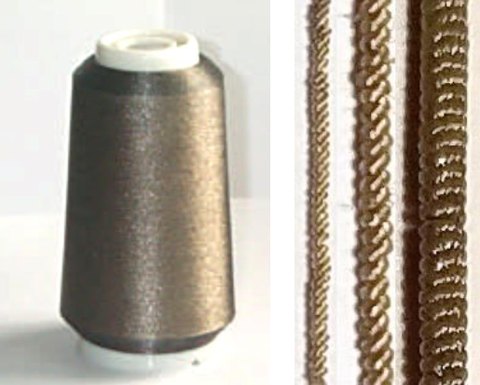
- Artificial muscles. How can cheap, lightweight actuators made from sewing thread, called twisted-and-coiled actuators (TCAs), drive soft robots? How do we model them from physics and control them, including using the muscle itself as a sensor?
- Fast and strong soft motion. Soft robots tend to be slow and weak. Can elastic instabilities and bistable structures, which store energy and release it in a snap, make them both fast and strong?
- Shape morphing. How can a robot soften its body, move into a new shape, and then lock that shape in place without external pumps or magnets, and without using power to hold it?
Key results
Soft robots driven by TCAs. A soft arm driven by twisted-and-coiled actuators with free strokes grips and moves a part.
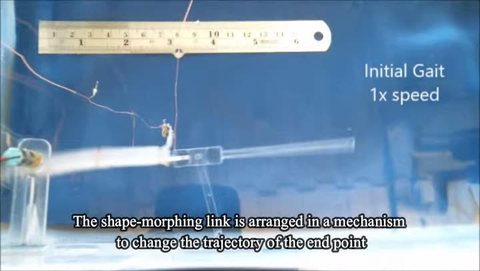
Controllable shape morphing. A link that softens, bends with a TCA, and locks changes the path of a mechanism.
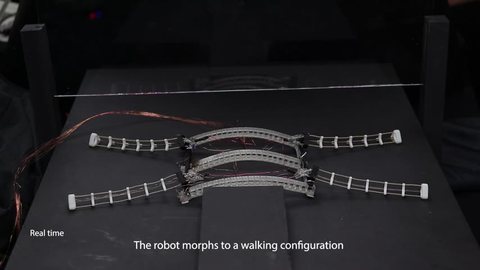
Embedded shape morphing. An amphibious robot turns its straight flippers into curved legs to walk out of the water.
Morphing grippers. A gripper reshapes its palm to fit objects from 20 to 126 mm wide.
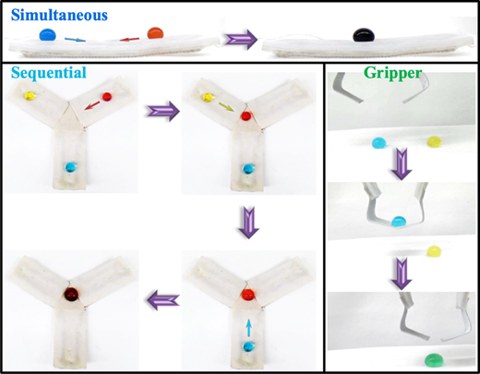
We have also built physics-based models of TCAs using Cosserat rod theory, controlled soft robot shapes with the Koopman operator, used elastic instabilities for fast and strong soft robots, and manipulated liquid droplets with a soft gripper.
Related robots
- Shape-Morphing Robots: grippers, a quadruped, and an amphibious robot that morph and lock their shape.
Publications
- Nat. Commun.
- ACC
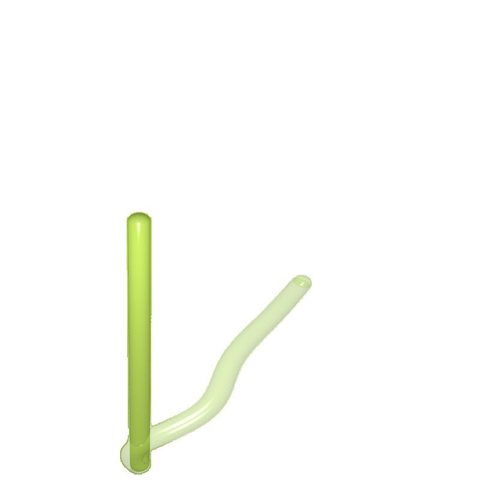 Controlling the Shape of Soft Robots Using the Koopman OperatorIn American Control Conference (ACC), 2023
- Mater. Horiz.
- T-RO
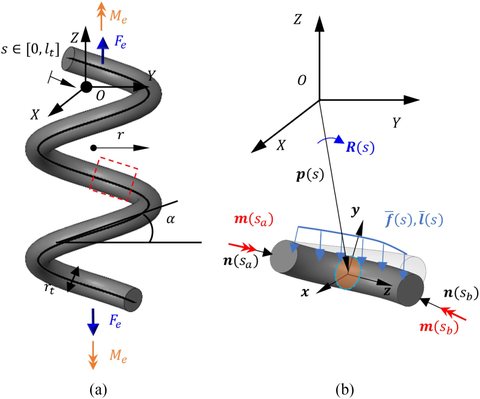 Physics-based Modeling of Twisted-and-Coiled Actuators Using Cosserat Rod TheoryIEEE Transactions on Robotics, 2022
- Soft Robot.
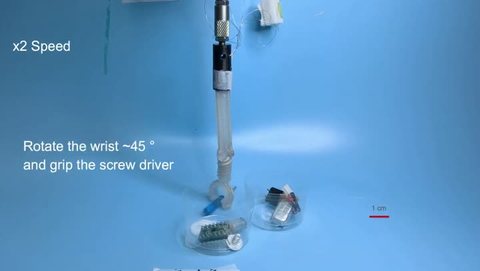 Twisted-and-Coiled Actuators with Free Strokes Enable Soft Robots with Programmable MotionsSoft Robotics, 2021
- Sci. Adv.
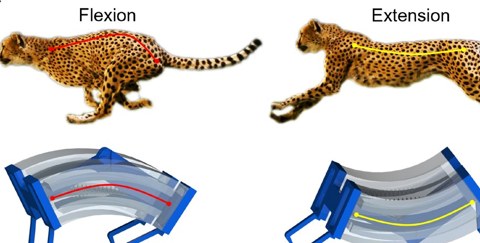 Leveraging Elastic Instabilities for Amplified Performance: Spine-Inspired High-Speed and High-Force Soft RobotsScience Advances, 2020
- ICRA
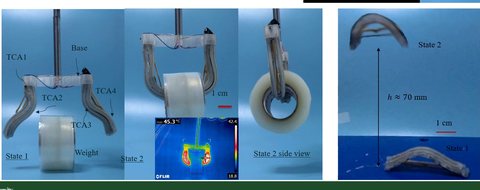 Tuning the Energy Landscape of Soft Robots for Fast and Strong MotionIn IEEE International Conference on Robotics and Automation (ICRA), 2020
- T-MECH
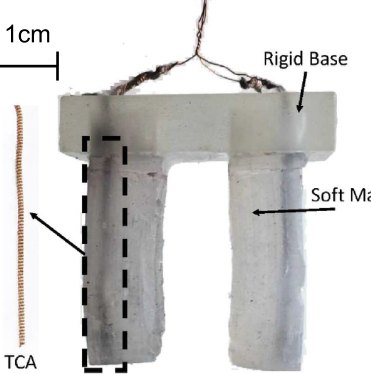 Modeling of Soft Robots Actuated by Twisted-and-Coiled ActuatorsIEEE/ASME Transactions on Mechatronics, 2019
- IROS
 Embedded and Controllable Shape Morphing with Twisted-and-Coiled ActuatorsIn IEEE/RSJ International Conference on Intelligent Robots and Systems (IROS), 2018Finalist for the Best Student Paper Award
- ICRA
 A Physics Based Model for Twisted and Coiled ActuatorIn IEEE International Conference on Robotics and Automation (ICRA), 2017